
Start With Wisconsin Records
Wisconsin is a statewide network of local custodians, not one resident database. A property question starts with the Wisconsin city, village, or town assessor and its land-information map. A deed or mortgage is held by the Wisconsin county Register of Deeds. A court case summary may appear in Wisconsin Circuit Court Access, while the Wisconsin Clerk of Circuit Court keeps the official file. For older names, the Wisconsin Historical Society, regional Area Research Centers, and local libraries hold directories, census records, newspapers, and other indexes.
Choose the record by the fact you need to confirm. Ownership is different from occupancy; an election lookup is not a street roster; and an old directory does not show where someone lives now. Keep the county or municipality with every result, since Wisconsin's 72 counties and local offices have different portals, years, and request steps.
- For a Wisconsin address, identify its municipality and parcel in the statewide map, then confirm the current assessment with the local assessor.
- For a Wisconsin court name, search WCCA by party and county, then ask the county clerk for the case file or courthouse terminal access.
- For a Wisconsin voter, use MyVote only to check that voter's own record, or ask the Elections Commission or local clerk about permitted public-list data.
- For a Wisconsin deed, carry the parcel's legal description or tax key to the county Register of Deeds index.
- For a Wisconsin family trail, search the library or Wisconsin Historical Society catalogs by place, year, and name before requesting older material.
Who Keeps Wisconsin Records
Wisconsin's records offices are split by record type. The county Register of Deeds records land instruments and issues eligible local vital certificates; Wisconsin county clerks administer elections and marriage-license functions; Wisconsin county court clerks keep court files. Municipal assessors maintain current property records. At the state level, Wisconsin DHS handles vital-record requests, the Wisconsin Elections Commission oversees voter data, and the Wisconsin Historical Society preserves public archives and genealogy collections.
Wisconsin State Archives
Wisconsin Historical Society, State Archives
Madison headquarters and 14 Area Research Centers
Regional holdings vary
Wisconsin Vital Records
Wisconsin DHS Vital Records
P.O. Box 309, Madison, WI 53701-0309
(608) 266-1373
Wisconsin Elections Commission
State voter information and public-list requests
County and municipal clerks hold local election records
Use the official WEC contact page
Wisconsin Parcel Records Start Locally
The Wisconsin State Cartographer's Office parcel map is a discovery layer, with about 3.56 million parcel records gathered from all 72 counties. Wisconsin's V12 source data was collected in the first half of 2026, and most tax-roll years in the release are 2025. Some small Wisconsin areas are not digitally mapped. The local assessor remains the current source for a parcel card, assessment year, and correction.
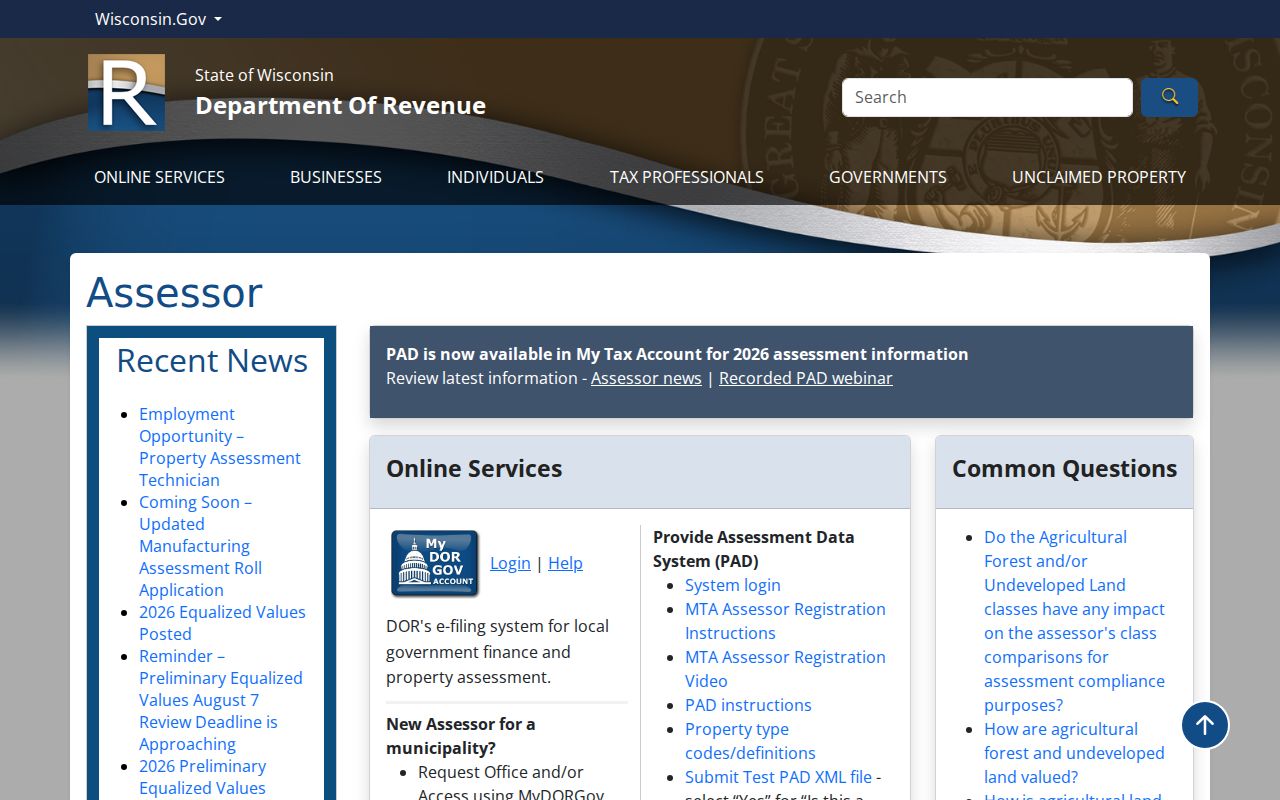
The Wisconsin Department of Revenue assessor page routes people to local municipal assessors rather than one statewide owner-name search. Its routing notes explain the statewide-to-local sequence; for a Wisconsin parcel, follow the named municipality's own property record.
When a Wisconsin parcel-map pop-up gives an owner name, site address, and mailing address, keep those fields separate. The owner may not live at the parcel, and the Wisconsin tax-mail destination may be a post office box, bank, lawyer, or former address. A recorded Wisconsin deed and its legal description are stronger evidence of title than a map label.
Read the Wisconsin site's physical address as the parcel location, the mailing field as the owner's tax-mail destination, and the legal description as the title key. Wisconsin parcel geometry is a map shape, not a survey or legal ownership boundary.
Wisconsin Address Records Use Four Labels
A single Wisconsin parcel can carry four geographic descriptions at once. The Wisconsin site address marks the physical property, the mailing address shows where tax mail is sent, USPS supplies a delivery city and ZIP, and the deed uses the legal description. These can point to different places without any record being wrong.
That difference matters when a Wisconsin residents directory search begins with a postal city. A Wisconsin ZIP can reach an unincorporated area or cross a municipal line, while an owner may get Wisconsin tax mail at another address. Use the county or municipality shown on the parcel record for the land question, and use the current USPS address lookup to confirm delivery wording. A Wisconsin postal last line does not set city limits.
- Parcel
- A mapped unit of land with an identifier in local assessment and tax records.
- Situs address
- The physical address of the land or building, as recorded by the assessor.
- Grantor and grantee
- The grantor transfers an interest; the grantee receives it in a deed or other instrument.
- Index
- A finding aid to records. It may show a reference without displaying the full filed document.
Current Wisconsin Resident Records
Modern Wisconsin records can connect a name to a property, a case, a registration, or a public credential, but none is a complete list of residents. The best first search depends on whether the person is checking their own record, whether a parcel is involved, or whether a past event needs verification.
| Wisconsin source | What it can confirm | Keeper | Access |
|---|---|---|---|
| Wisconsin local assessor and parcel map | Owner, parcel, site and mailing fields | Municipal assessor; county land office | Local portal, map, counter, or request |
| Wisconsin WCCA / CCAP | Public circuit case parties, dates, and status | Wisconsin Court System; county clerk | Statewide summary; courthouse file |
| Wisconsin MyVote and voter list | Own registration, or permitted public-list fields | Wisconsin Elections Commission; local clerks | Personal search or written data request |
| Wisconsin DHS and county vital records | Eligible birth, death, marriage, and divorce event | Wisconsin DHS; county Register of Deeds | Form, mail, VitalChek, or county counter |
| Wisconsin DSPS credential search | Public professional or trade credential and status | Department of Safety and Professional Services | Online category search |
A title in a people record can be a lead, not a verdict. Property records describe ownership; MyVote's public name path is for the registered voter to check their own record; and a court summary is not the same as the papers in the county file. A Wisconsin residents directory search should pair those sources with dates, county, case number, or family details before treating two records as the same person.
Wisconsin Resident Searches on MyVote
Wisconsin's MyVote screen has two separate paths: one for people checking their own registration and another for finding polling place and ballot information by address. The address search is not a list of everyone who votes near a home. Wisconsin does not register voters by party, and ballot choices are never part of the public record.
Wisconsin's public registration list is governed by Wis. Stat. § 6.36 and Wis. Admin. Code EL 3.50. A written request to the Wisconsin Elections Commission or a county or municipal clerk can seek permitted list data, with protected details removed. The Wisconsin resident lookup explains MyVote's search paths, their limits, and how to request permitted voter-list data.
Wisconsin Court Records Need Context
Wisconsin Circuit Court Access, often called WCCA or CCAP, lets the public search circuit-court summaries across all 72 counties. Start with a likely name and county, then compare the result's role, dates, type, and status before deciding whether it fits.
The Wisconsin web result is not the whole case file. The Wisconsin county Clerk of Circuit Court keeps filed papers and the official judgment or lien docket; courthouse public-access computers may show documents that are not online. Older coverage depends on when a county converted or backloaded its records. Juvenile, adoption, child-protection, and other confidential case types do not appear as ordinary public cases, and some identity or address fields are redacted.
| Wisconsin court route | Access and cost | What to expect |
|---|---|---|
| Wisconsin WCCA public summary | Free online search | Caption, county, case number, filing date, status, events |
| Wisconsin courthouse terminal | Public inspection; ask the county clerk about access | May show filed documents that are not on the web |
| Certified copy | County or statutory copy fees may apply | Request from the county that holds the official file |
Wisconsin Vital Records Change by Era
Wisconsin county registration began in 1852, but reporting was uneven until about 1880. The Wisconsin Historical Society's pre-October 1907 index is valuable and incomplete; an absent Wisconsin name can reflect a missed registration rather than an absent event. Older Wisconsin birth, death, and marriage records may be indexed online, then viewed on microfilm at the Society or an Area Research Center. The reels are arranged by county and registration date, which may differ from the event date.
For events from October 1907 forward, Wisconsin DHS and county Registers of Deeds provide eligible certified copies. The state does not publish a current public online vital index. A mailed request uses an application, ID, payment, and required envelope; DHS also takes VitalChek orders by web or phone, and county counters may serve local events. Fees and eligibility vary by record and relationship, especially for recent deaths, so review the current application before ordering.
A divorce certificate is a short vital record. A divorce decree is the detailed court judgment and comes from the county Clerk of Circuit Court. For pre-1907 family history, begin with the Wisconsin Historical Society family-history collections; for a modern certificate, use the DHS application list and the right county office.
Wisconsin Business and License Records
Some Wisconsin identity questions are about a public business or credential, not a home address. The Wisconsin Department of Financial Institutions Corporate Records Search can show a legal entity name, type, registration date, registered agent and office, entity ID, charter history, status, and most recent annual-report year. It does not list all domestic LLC members, FEINs, phone numbers, sole proprietors, trade names, or general-partnership owners unless a statement was filed.
The Wisconsin DSPS Credential and License Search separates individual, organization, and trade records. Its modes use different fields, so choose the kind of Wisconsin credential before entering a name or number. Results may show credential number, profession, status, issue and expiration dates, and location fields. An official verification can be a separate paid product; a public status result is not a residential record.
| Wisconsin DSPS search mode | Captured search fields | What to compare |
|---|---|---|
| Individual | Profession, last and first name, credential number | Credential identity and current status |
| Organization | Profession, credential number, organization name or partial name | Firm or business credential |
| Trades advanced | Credential type, required status, five-digit or partial ZIP, last or business name | Trade license and displayed location |
Request Wisconsin Records Offline
When a Wisconsin portal does not reach the record year or field, contact the named custodian. Start with the Wisconsin county Register of Deeds for a land instrument, the Wisconsin Clerk of Circuit Court for a case file, or the municipality for assessor, permit, or local-license records. The Wisconsin Historical Society's catalog can show whether older public records were transferred to one of its regional centers. A Wisconsin library may also hold microfilm, local newspapers, yearbooks, directories, and indexes that are not online.
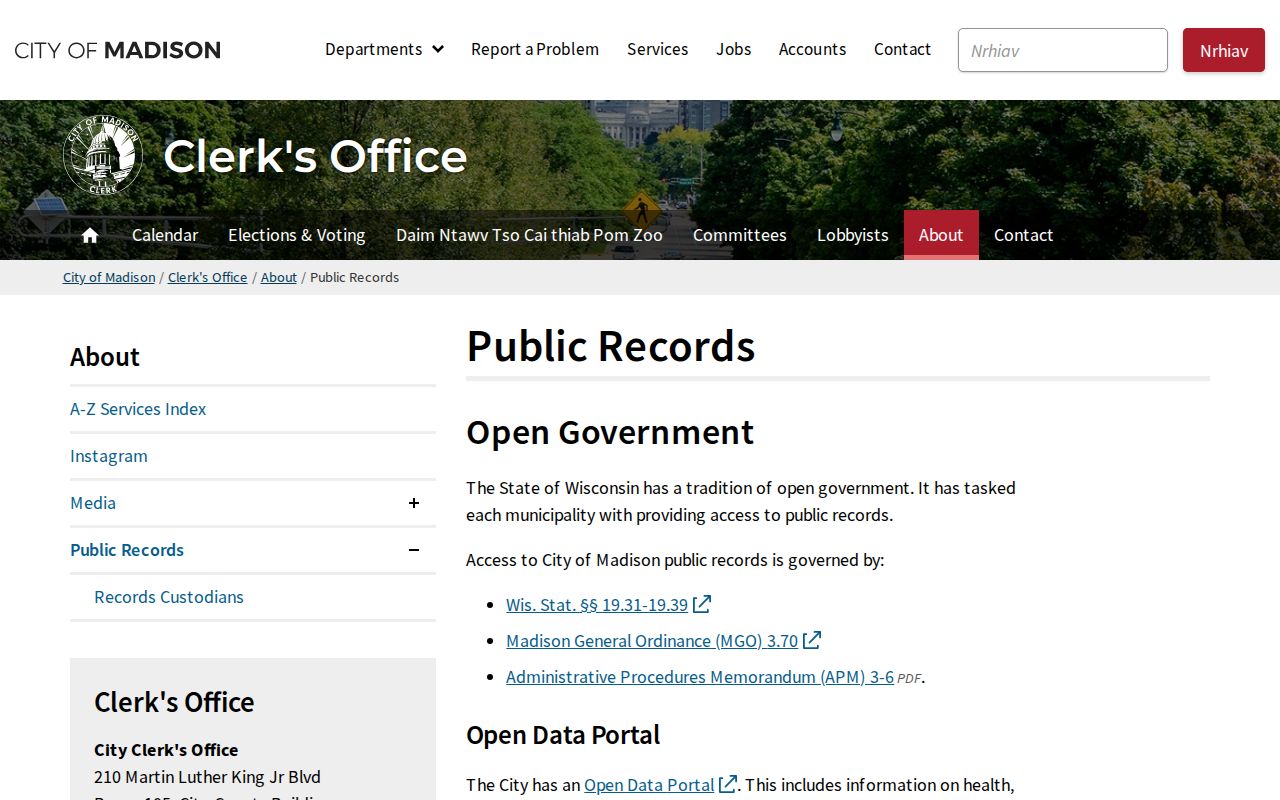
Wisconsin Public Records Law, Wis. Stat. §§ 19.31-19.39, has no fixed response deadline. The authority must respond as soon as practicable and without delay. It may charge actual, necessary, and direct costs for reproduction, locating, or mailing; locating fees generally begin when the cost is $50 or more, and prepayment may apply when the total exceeds $5. A clear written request can name the record, date range, format, and delivery method. Ask for the index reference before paying for a certified copy.
Madison shows what a Wisconsin local request can look like, but its process and fees are not a statewide rule. Its Public Records Request Center routes a request to the right department and supports tracking and online payment; the City Clerk's Office also accepts in-person and written requests at 210 Martin Luther King Jr. Blvd., Room 105, Madison, WI 53703, or at (608) 266-4601, Monday through Friday, 8:00 a.m. to 4:30 p.m. Use the Madison custodian and records-request page as a Wisconsin example, then check the county or city you actually need.
The Madison request center screen shows how a local request can be sent to a department and tracked.
Wisconsin's Historical Resident Directories
Wisconsin's directory shelves are spread across local libraries, the Wisconsin Historical Society, its 14 Area Research Centers, UW collections, and library databases. Milwaukee Public Library lists city directories from 1847 to the present, with some years missing; name browsing spans the run, while address browsing begins in 1921. The Zeidler Room holds print, microform, and online formats, including a 1930 Address Change Directory. Madison has digitized 1871-72 and 1883-84 volumes, and the Historical Society hosts a 1913 title for Janesville's Wright Directory Co.
A directory can link a name to an address and sometimes an occupation or household note for the year printed. It does not prove ownership or current occupancy. Use the front matter to read abbreviations, and pair a directory year with census, deed, obituary, or parcel records. The Wisconsin city directory collections have the full year-by-year routes and reading method.
The Wisconsin Historical Society's Wisconsin Name Index contains obituary scrapbooks, local histories, biographies, and selected newspaper material, mostly from 1870 to 1970. Its Local History and Biographical Articles collection adds 16,000 digitized articles, mostly 1860 to 1940. The index is a lead list, not a full scan of every shelf. If a name is missing online, search the Area Research Center catalog by county, former town, organization, and surname, then ask the holding library about access or transfer.
Wisconsin Archives Preserve Resident Records
The Society's 14 Area Research Centers serve regional collections, including local government files, court records, tax rolls, maps, school material, newspapers, directories, and family-history items. Records are processed in Madison and returned to the regional center that serves the county. Some books and microforms can be requested through another center, while rare genealogy material may need to be used onsite. Confirm the repository, collection title, and current access terms before traveling.
Wisconsin's scale is visible in a few figures: the family-history search indexes more than three million records; the pre-1907 collection includes roughly one million births, one million marriages, and 400,000 deaths; original naturalization records survive for 70 of 72 counties; and the Historical Society holds Sanborn maps for 325 Wisconsin communities. Those counts help set search expectations, but no one index contains every name. Search across the Wisconsin residents directory's modern and historic record paths, and keep dates and jurisdictions attached to each result.
Note: A local archive may hold records for a county other than the one where the center is located, so check the catalog record for the repository.