
Start With Wisconsin Records
Wisconsin runs on local custodians, not one resident database. Property questions start with the city, village, or town assessor and its land-information map. Deeds sit with the county Register of Deeds. Case summaries may appear in Wisconsin Circuit Court Access. The Clerk of Circuit Court keeps the official file. Older names turn up at the Wisconsin Historical Society, regional Area Research Centers, and local libraries, which hold directories, census records, newspapers, and other indexes.
Match the record to the fact you need. Ownership is not occupancy. A name in an election lookup is not a street roster entry either. An old directory is not a current address. Keep the county or municipality with every result, because Wisconsin's 72 counties and local offices run different portals, years, and request steps.
- For a Wisconsin address, identify its municipality and parcel in the statewide map, then confirm the current assessment with the local assessor.
- For a Wisconsin court name, search WCCA by party and county, then ask the county clerk for the case file or courthouse terminal access.
- For a Wisconsin voter, use MyVote only to check that voter's own record, or ask the Elections Commission or local clerk about permitted public-list data.
- For a Wisconsin deed, carry the parcel's legal description or tax key to the county Register of Deeds index.
- For a Wisconsin family trail, search the library or Wisconsin Historical Society catalogs by place, year, and name before requesting older material.
Who Keeps Wisconsin Records
Wisconsin splits its records offices by record type. The county Register of Deeds records land instruments and issues eligible local vital certificates. County clerks administer elections and marriage-license functions. Court clerks keep the court files. Municipal assessors maintain current property records. At the state level, DHS handles vital-record requests, the Elections Commission oversees voter data, and the Historical Society preserves public archives and genealogy collections.
Wisconsin State Archives
Wisconsin Historical Society, State Archives
Madison headquarters and 14 Area Research Centers
Regional holdings vary
Wisconsin Vital Records
Wisconsin DHS Vital Records
P.O. Box 309, Madison, WI 53701-0309
(608) 266-1373
Wisconsin Elections Commission
State voter information and public-list requests
County and municipal clerks hold local election records
Use the official WEC contact page
Wisconsin Parcel Records Start Locally
The Wisconsin State Cartographer's Office parcel map is a discovery layer holding about 3.56 million parcel records from all 72 counties. Wisconsin's V12 source data was collected in the first half of 2026. Most tax-roll years in the release are 2025. Some small areas are not digitally mapped. The local assessor remains the current source for a parcel card, an assessment year, or a correction.
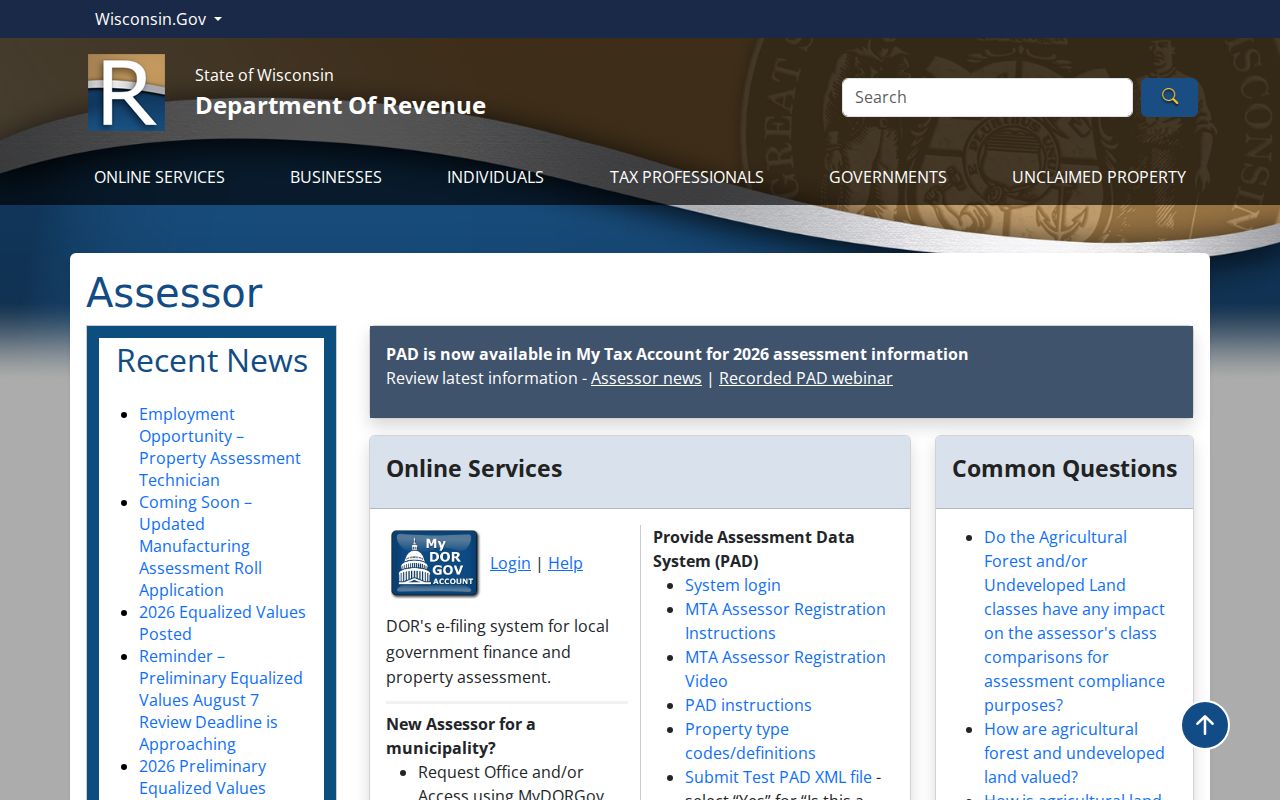
The Wisconsin Department of Revenue assessor page routes people to local municipal assessors rather than one statewide owner-name search. The notes explain the statewide-to-local sequence. Then follow the named municipality's own property record.
A Wisconsin parcel-map pop-up may show an owner name, a site address, and a mailing address. The owner may not live at the parcel. The tax-mail destination may be a post office box, a bank, a lawyer, or a former address. A recorded Wisconsin deed and its legal description are stronger evidence of title than any map label.
Read the site address as the parcel location. The mailing field is the tax-mail destination. The legal description is the title key. Parcel geometry is a map shape, not a survey or legal ownership boundary.
Wisconsin Address Records Use Four Labels
One Wisconsin parcel can carry four addresses at once. The site address marks the physical property. The mailing address shows where tax mail is sent. USPS supplies a delivery city and ZIP, and the deed uses the legal description. These can point to different places without any record being wrong.
That difference matters when a Wisconsin residents directory search begins with a postal city, because a Wisconsin ZIP can reach an unincorporated area or cross a municipal line. An owner may get tax mail at another address. Use the county or municipality on the parcel record for the land question. Use the current USPS address lookup to confirm delivery wording. A postal last line does not set city limits.
- Parcel
- A mapped unit of land with an identifier in local assessment and tax records.
- Situs address
- The physical address of the land or building, as recorded by the assessor.
- Grantor and grantee
- The grantor transfers an interest; the grantee receives it in a deed or other instrument.
- Index
- A finding aid to records. It may show a reference without displaying the full filed document.
Current Wisconsin Resident Records
Modern Wisconsin records can connect a name to a property, a case, a registration, or a public credential. None is a complete list of residents. The best first search depends on the question. It matters whether the person is checking their own record, whether a parcel is involved, or whether a past event needs verification.
| Wisconsin source | What it can confirm | Keeper | Access |
|---|---|---|---|
| Wisconsin local assessor and parcel map | Owner, parcel, site and mailing fields | Municipal assessor; county land office | Local portal, map, counter, or request |
| Wisconsin WCCA / CCAP | Public circuit case parties, dates, and status | Wisconsin Court System; county clerk | Statewide summary; courthouse file |
| Wisconsin MyVote and voter list | Own registration, or permitted public-list fields | Wisconsin Elections Commission; local clerks | Personal search or written data request |
| Wisconsin DHS and county vital records | Eligible birth, death, marriage, and divorce event | Wisconsin DHS; county Register of Deeds | Form, mail, VitalChek, or county counter |
| Wisconsin DSPS credential search | Public professional or trade credential and status | Department of Safety and Professional Services | Online category search |
A title in a people record is a lead, not a verdict. Property records describe ownership. MyVote's public name path is for the registered voter checking their own record. A court summary is not the case file. Pair those sources with dates, county, case number, or family details. Only then treat two records as one person.
Wisconsin Resident Searches on MyVote
Wisconsin's MyVote screen splits into two paths. One lets a voter check their own registration. The other finds a polling place and ballot details by address. Neither path lists everyone who votes near a home. Wisconsin also skips party registration entirely, and ballot choices never become public record.
The public registration list works differently. Wis. Stat. § 6.36 and Wis. Admin. Code EL 3.50 govern it, and a written request to the Wisconsin Elections Commission or a county or municipal clerk can obtain permitted data with protected details stripped out. The Wisconsin resident lookup walks through MyVote's search paths, their limits, and how to request voter-list data lawfully.
Wisconsin Court Records Need Context
Wisconsin Circuit Court Access, usually called WCCA or CCAP, opens circuit-court summaries to the public. It covers all 72 counties. Try a likely name and county first. Then weigh the role, dates, case type, and status before trusting a match.
The online summary is not the file itself. The county Clerk of Circuit Court holds the filed papers plus the official judgment or lien docket. Courthouse public terminals sometimes display documents absent from the web version. Older coverage hinges on when each county converted or backloaded its records. Juvenile, adoption, and child-protection cases stay confidential, and some identity or address fields are redacted.
| Wisconsin court route | Access and cost | What to expect |
|---|---|---|
| Wisconsin WCCA public summary | Free online search | Caption, county, case number, filing date, status, events |
| Wisconsin courthouse terminal | Public inspection; ask the county clerk about access | May show filed documents that are not on the web |
| Certified copy | County or statutory copy fees may apply | Request from the county that holds the official file |
Wisconsin Vital Records Change by Era
Wisconsin counties began registering vital events in 1852. Reporting stayed uneven until roughly 1880. The Wisconsin Historical Society's pre-October 1907 index is valuable yet incomplete. So a missing Wisconsin name may mean a missed registration rather than no event at all. Many older birth, death, and marriage records are indexed online. They are also viewable on microfilm at the Society or an Area Research Center. The reels run by county and registration date, which can differ from the event date.
From October 1907 forward, Wisconsin DHS and county Registers of Deeds issue certified copies to eligible applicants. The state publishes no current public online vital index. A mailed request needs an application, ID, payment, and a required envelope. DHS also takes VitalChek orders online or by phone. County counters may handle local events. Fees and eligibility depend on the record and your relationship to it, especially for recent deaths. So read the current application before ordering.
A divorce certificate is a brief vital record. The divorce decree is the full court judgment. It is held by the county Clerk of Circuit Court. For pre-1907 family history, start with the Wisconsin Historical Society family-history collections. For a modern certificate, use the DHS application list and the right county office.
Wisconsin Business and License Records
Some Wisconsin lookups target a business or credential rather than a home address. The Wisconsin Department of Financial Institutions Corporate Records Search can surface a legal entity name, type, registration date, registered agent and office, entity ID, charter history, status, and latest annual-report year. It skips some things, though. Domestic LLC members, FEINs, phone numbers, sole proprietors, trade names, and general-partnership owners stay off the list. Exceptions apply unless a statement was filed.
The Wisconsin DSPS Credential and License Search sorts individual, organization, and trade records into separate modes. Each mode has different fields. Pick the credential type before entering a name or number. Results may include credential number, profession, status, issue and expiration dates, and location fields. Official verification can be a separate paid product. A public status result is not a residential record.
| Wisconsin DSPS search mode | Captured search fields | What to compare |
|---|---|---|
| Individual | Profession, last and first name, credential number | Credential identity and current status |
| Organization | Profession, credential number, organization name or partial name | Firm or business credential |
| Trades advanced | Credential type, required status, five-digit or partial ZIP, last or business name | Trade license and displayed location |
Request Wisconsin Records Offline
When a Wisconsin online directory stops short of the record year or field you need, go straight to the custodian named for that record. A land instrument belongs with the county Register of Deeds. A case file sits with the Clerk of Circuit Court. Assessor, permit, and local-license records stay with the municipality. The Wisconsin Historical Society's catalog can reveal whether older public records were moved to one of its regional centers, and a Wisconsin library may hold microfilm, local newspapers, yearbooks, directories, and indexes that never reached the web.
Wisconsin Public Records Law, Wis. Stat. §§ 19.31-19.39, sets no fixed response deadline. The authority must respond as soon as practicable and without delay. Fees cover actual, necessary, and direct costs of reproduction, locating, or mailing. Locating fees generally begin once the cost reaches $50 or more, and prepayment may apply above $5. A clear written request should name the record, date range, format, and delivery method. Ask for the index reference before paying for a certified copy.
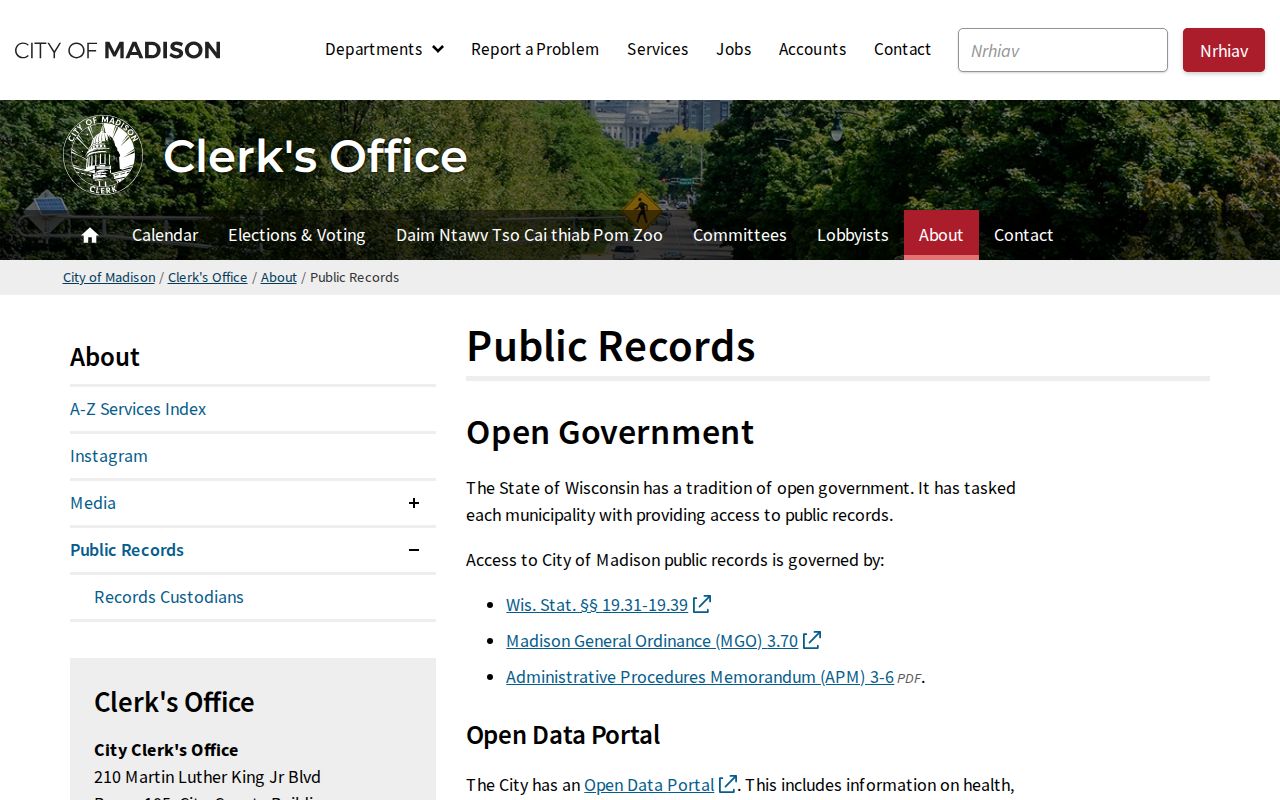
Madison illustrates how a local Wisconsin request works, though its process and fees are not a statewide rule. Its Public Records Request Center routes a request to the right department and supports tracking and online payment. The City Clerk's Office also accepts in-person and written requests at 210 Martin Luther King Jr. Blvd., Room 105, Madison, WI 53703, or at (608) 266-4601, Monday through Friday, 8:00 a.m. to 4:30 p.m. Use the Madison custodian and records-request page as one Wisconsin example, then check the county or city you actually need.
The Madison request center screen shows how a local request can be sent to a department and tracked.
Wisconsin's Historical Resident Directories
Old Wisconsin directories live in more places than most people expect. Local libraries, the Wisconsin Historical Society, its 14 Area Research Centers, UW collections, and library databases all hold pieces of the shelf. Milwaukee Public Library carries city directories from 1847 to the present, though some years are missing. Browsing by name works across the whole run. Address browsing starts in 1921. The Zeidler Room keeps print, microform, and online formats, including a 1930 Address Change Directory. Madison has digitized the 1871-72 and 1883-84 volumes. The Historical Society hosts a 1913 title for Janesville's Wright Directory Co.
A directory entry ties a name to a street address. It sometimes adds an occupation or a household note for the year printed. It proves neither ownership nor current occupancy. Read the front matter for abbreviations. Pair a directory year with census, deed, obituary, or parcel records. The Wisconsin city directory collections lay out the full year-by-year routes and reading method.
The Wisconsin Historical Society's Wisconsin Name Index gathers obituary scrapbooks, local histories, biographies, and selected newspaper material. Most of it falls between 1870 and 1970. Its Local History and Biographical Articles collection adds 16,000 digitized articles, mostly 1860 to 1940. Treat the index as a lead list rather than a full scan. When a name is missing online, search the Area Research Center catalog by county, former town, organization, and surname. Then ask the holding library about access or transfer.
Wisconsin Archives Preserve Resident Records
The Society's 14 Area Research Centers serve regional collections of every kind. Local government files, court records, tax rolls, maps, school material, newspapers, directories, and family-history items all pass through them. Records are processed in Madison and returned to the regional center serving the county. Some books and microforms can be requested through another center. Rare genealogy material may need onsite use. Confirm the repository, collection title, and current access terms before traveling.
The scale of Wisconsin's holdings shows in a few numbers. The family-history search indexes more than three million records. The pre-1907 collection holds roughly one million births, one million marriages, and 400,000 deaths. Original naturalization records survive for 70 of 72 counties. The Historical Society keeps Sanborn maps for 325 Wisconsin communities. Those counts set fair expectations, but no single index contains every name. Search across the Wisconsin residents directory's modern and historic record paths. Keep dates and jurisdictions attached to each result.
Note: A local archive may hold records for a county other than the one where the center is located, so check the catalog record for the repository.