
Wisconsin Resident Lookup: What It Shows
Wisconsin has no single official search for everyone who currently lives in the state. A Wisconsin person-specific search is a set of narrower checks, each tied to a different public purpose and office. Wisconsin property data can connect a person to ownership, while voter registration is best checked through the person's own MyVote record or a permitted Wisconsin data request. Wisconsin court and vital records answer event questions; business and credential records can confirm a public affiliation. This Wisconsin source table separates those uses so a result is not asked to prove more than it does.
| Record set | Useful confirmation | Wisconsin source | How to reach it |
|---|---|---|---|
| Parcel and assessment | Wisconsin property owner, parcel, site and mailing-address clues | Wisconsin local assessor; State Cartographer's Office map | Online Wisconsin discovery, then local assessor or land-information office |
| Voter record | Own registration and voting history, or permitted public-list fields | Wisconsin MyVote; Elections Commission; local clerk | Personal lookup online; Wisconsin list data by written request, subject to redaction and fees |
| Court file | Public Wisconsin case parties, dates, events and status | Wisconsin WCCA/CCAP; DOJ WORCS; county Clerk of Circuit Court | Statewide web summary; paid adult-history check; Wisconsin courthouse terminal or clerk for filed documents |
| Vital event | Eligible Wisconsin birth, death, marriage or divorce record | Wisconsin DHS Vital Records; county Register of Deeds; WHS historical index | Mail, VitalChek, county office, historical index and Wisconsin microfilm |
| Business or credential | Wisconsin entity status, agent or public license status | DFI Corporate Search; DSPS Credential Search | Online Wisconsin search; custodian or board for filings and official verification |
Begin with the record that matches the question, then keep its date and Wisconsin scope attached to the result. If the question is whether an older relative lived in a place, a Wisconsin historical index or library collection may be more useful than a current online search. For a property transfer, follow the parcel clue to the Wisconsin county deed record. For a court event, use WCCA for the statewide lead and the county file for detail. This kind of Wisconsin search becomes reliable through corroboration, not by collecting the largest number of hits.
Wisconsin Resident Court Search in WCCA
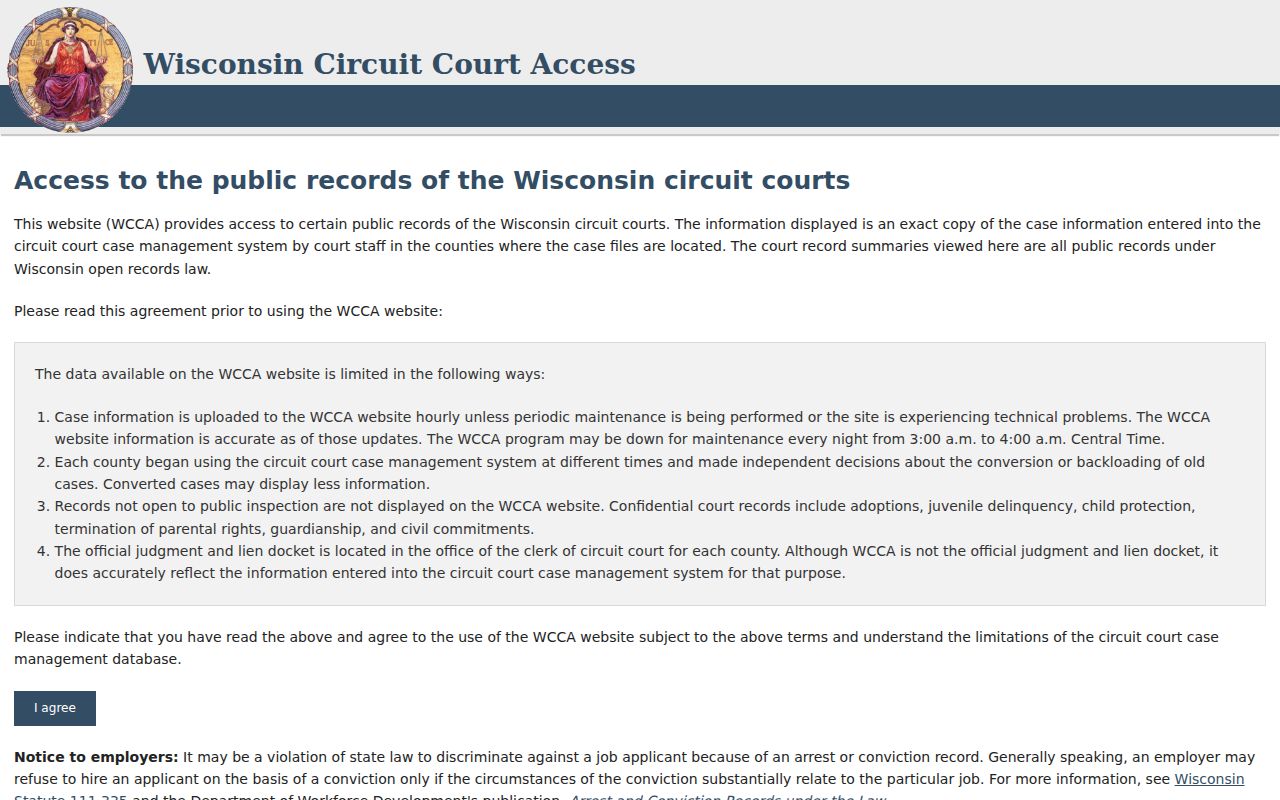
Wisconsin Circuit Court Access (WCCA), also called CCAP, is the statewide public view of Wisconsin circuit-court case summaries. Its agreement screen leads to simple and advanced searches, judgment search, reports and help. Search Wisconsin statewide first, then narrow by county or other known detail. Wisconsin counties adopted the system at different times, and older cases may not have the same online coverage everywhere. The Wisconsin case-search hub also routes researchers to appellate and municipal-court information.
The Wisconsin search fields help separate people with the same name. Use the names and date or county details you already know, and treat a match as a lead until the case context fits.
| Field label | Type | Required | Options and format notes |
|---|---|---|---|
| Party Name: last, first, middle | Text | One criterion required in simple name mode | Search spelling variants; starting with first and last only is recommended. |
| Birth Date | Date | Optional | Can narrow a same-name result; full date is not broadly displayed. |
| Business Name | Text | Alternate name criterion | Search an entity party instead of an individual. |
| County | Dropdown | Optional | Choose statewide or a Wisconsin county. |
| Case Number | Text | Alternate criterion | Use the year, case-type code and sequence when known. |
| Filing date From/To | Date pair | Optional, advanced | Narrow by filing period where available. |
| Case type/group | Dropdown | Optional, advanced | Options include civil, criminal, family, probate, traffic and other court-defined groups. |
| Judgment Search criteria | Text or date | Alternate tab | Search judgment or lien information; the official docket stays with the county clerk. |
| Reports/calendar controls | Tab, dropdown or date | Optional | Browse reports or calendars, not an unrestricted person directory. |
The Wisconsin WCCA search page shows the agreement and simple-search screen. A public Wisconsin case result can include several fields that help test a name match:
- Wisconsin case caption, party names and the role each person has in the case.
- County, case number, case type, filing date and current case status.
- Event history such as court dates, filings, orders, charges, dispositions and judgment-related entries.
- Document-access clues showing that the web summary does not contain every filed paper or transcript.
- Fields withheld or redacted for confidential case types and protected personal information.
The WCCA search page shows the agreement and simple-search screen pictured below.
For Wisconsin court papers and fuller inspection, contact the county Clerk of Circuit Court or use the public-access computer at the Wisconsin county courthouse. Ask about archived files, certification and local copy charges. A Wisconsin municipal citation may belong to a separate municipal court, while a federal case goes through PACER. These routes matter when a Wisconsin web search has no match or lacks the document needed to answer the question.
For a separate adult criminal-history name check, Wisconsin DOJ's WORCS request portal accepts paid online requests for Wisconsin records. It is not a substitute for a court file and may not include juvenile, sealed, expunged, out-of-state or missing-disposition matters.
The Wisconsin Court System case-search hub lists the statewide court-search routes and the boundaries between them.
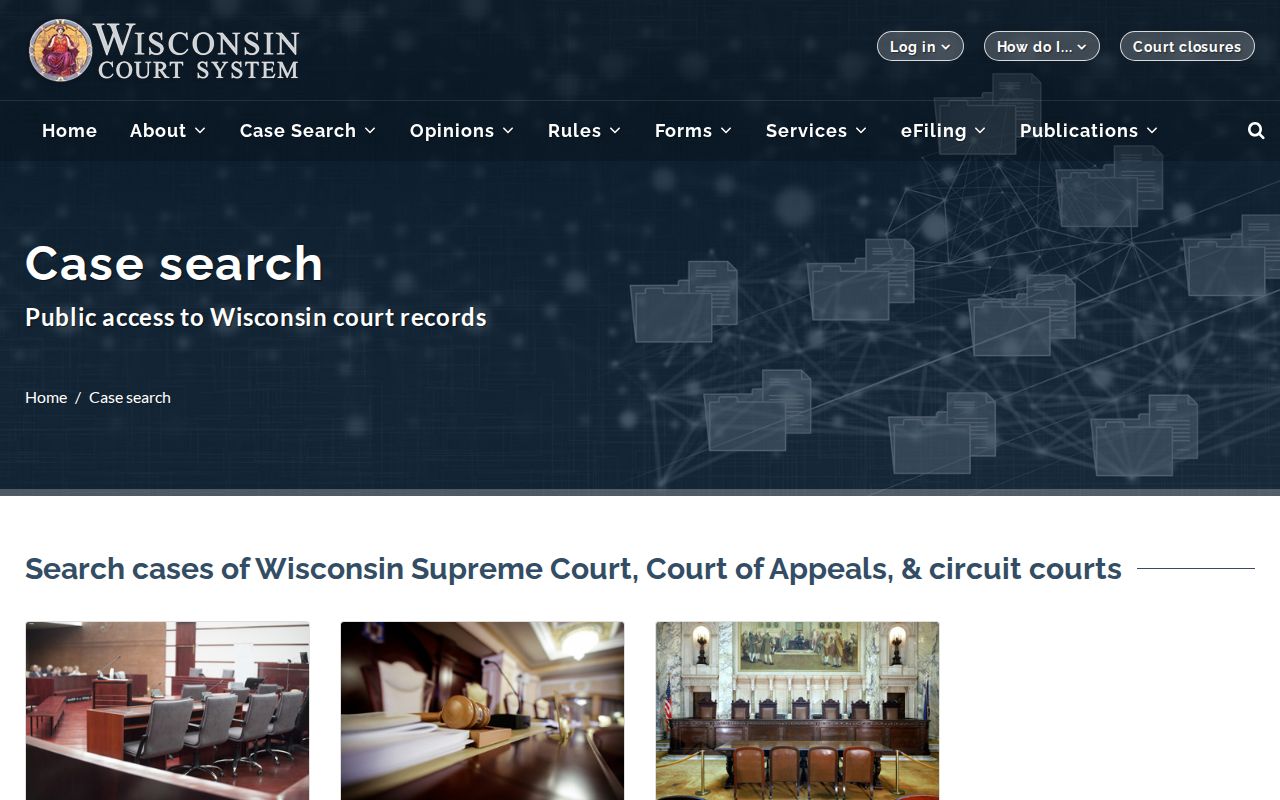
Use the hub to choose the circuit-court summary search or the appellate case system, depending on the record needed. It is a routing page rather than a detailed case file; the county clerk remains the contact for circuit-court documents, while appellate materials follow their own portal and clerk process.
Verify a Wisconsin Resident Match
Use a small, deliberate chain when confirming one person. Start from what is already known and add a different kind of Wisconsin record at each step. An owner name alone does not establish occupancy, a docket does not tell a whole life story, and an old vital index may point to an event rather than a living person. For a family-history question, compare place, date, relatives and the original record where access permits.
- Write down the full name, likely Wisconsin county or town, and any known date or relationship. Keep spelling variants separate rather than assuming they identify one person.
- Use a Wisconsin assessor or parcel result only to test an ownership connection. Compare the owner and mailing address with the parcel's site address; follow a legal transfer through the Wisconsin county Register of Deeds if that is the question.
- Search WCCA for the name and plausible variants, then compare county, case type, dates, party role and case number. Request the actual county file when the summary is insufficient.
- Check an eligible Wisconsin vital record or historical index for event date, place and family details. Treat each agreement as one clue, and stop short of asserting a current address from an old record.
For court results, a useful inventory is the caption and party role; county, case number, case type and filing date; status; and the event history. Public web access may omit filed documents and confidential case types. A dismissal or not-guilty disposition is not a reason to treat unrelated records as proof of identity, and an apparent same-name result is not conclusive.
- Docket
- The court's organized case record, with parties, dates, entries and status; the online view may show only part of it.
- Index and image
- An index points to a record by names or other keys. An image is a view of the record itself, when one is available for public access.
- Certified copy
- A copy issued by the record custodian with formal certification; eligibility, fee and application rules depend on the record.
Wisconsin Residents and MyVote's Own Record
Wisconsin's MyVote My Voter Info has two paths that answer different questions. The name path is for a person's own registration record and requires first name, last name and birth date. The address path returns Wisconsin polling-place and ballot information for an address; it is not a reverse directory of the people at that location. The distinction matters when someone wants to look up a Wisconsin resident from a street address rather than check their own registration.
| Field label | Type | Required | Options and format notes |
|---|---|---|---|
| First Name | Text | Yes for name search | Full name field displayed on the Wisconsin MyVote form. |
| Last Name | Text | Yes for name search | Full name field displayed on the Wisconsin MyVote form. |
| Birth Date | Date | Yes for name search | Required to view the person's own Wisconsin registration record. |
| Street Address | Text | Yes for address search | Physical Wisconsin address search field. |
| Unit | Text | Shown as required for address search | Enter Wisconsin apartment or unit details when applicable. |
| City | Text | Yes for address search | Wisconsin municipality or locality for the address search. |
| ZIP | Text | Yes for address search | Five-digit Wisconsin ZIP field. |
| Search by Name / Search by Address | Tab or radio | Choose one mode | Name path checks the user's own record; address path returns polling and ballot information. |
| Search for My Voter Record | Button | Submit | Name path. |
| Search by Address | Button | Submit | Address path. |
The official MyVote form shows those required fields. For a Wisconsin public registration list or custom report, request access from the Wisconsin Elections Commission or county or municipal clerk. Wis. Stat. § 6.36 and Wis. Admin. Code EL 3.50 govern inspection, protected data and report charges. A written request makes the requested time period, fields and format clear; custom reports must be written or reduced to writing by Wisconsin Elections Commission staff. Electronic report charges start with a $25 base fee plus $5 for up to the first 1,000 records and each additional 1,000, up to $12,500; paper is charged at $0.25 per page plus postage and shipping.
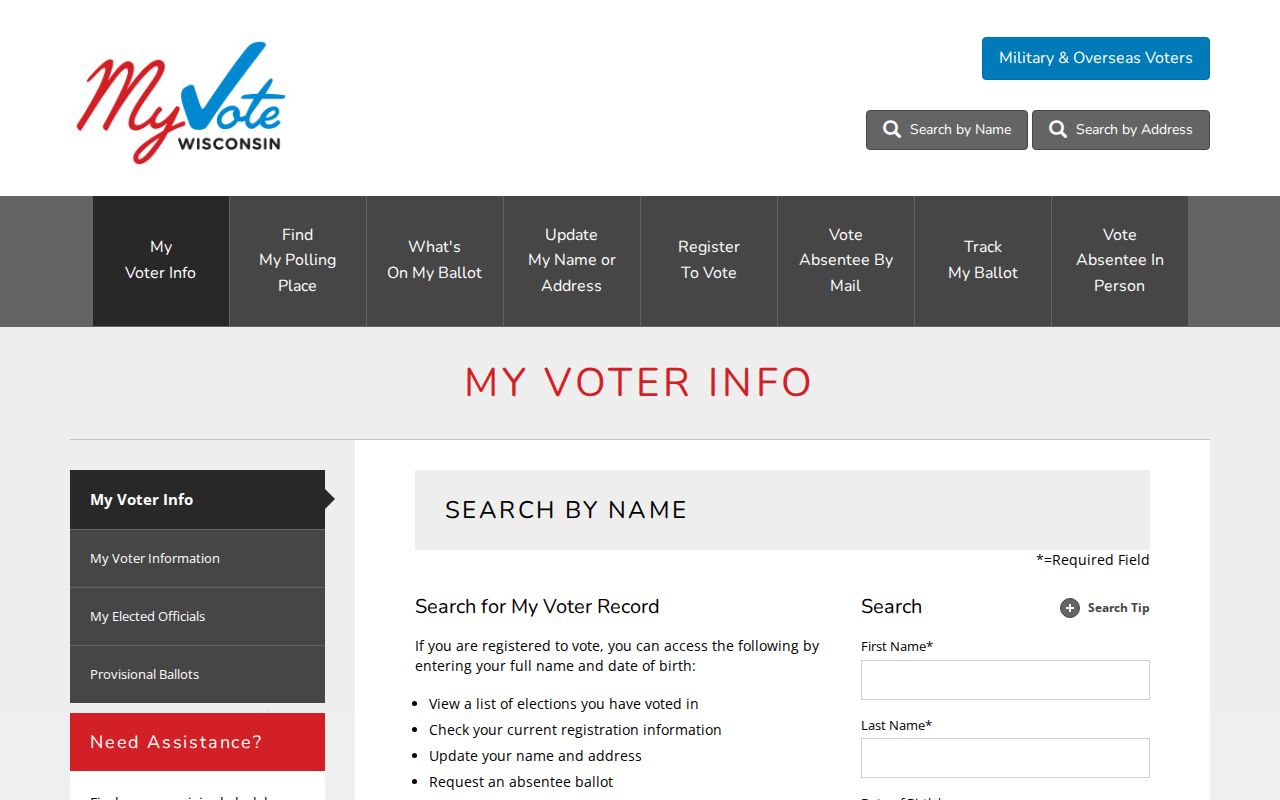
A public-list result may include these permitted fields, while withholding protected details:
- Wisconsin elector name, residence address, mailing address where maintained, and municipality, ward or precinct.
- Registration status and date where available, plus elections participated in or voting history as permitted.
- Protected fields include full birth date, operator's-license number, Social Security number, confidential-elector address and voting accommodations.
Wisconsin does not register voters by party, and ballot choices are never public fields. MyVote's name search is for the voter's own record, and an old or inactive registration is not proof that a person still lives at the recorded address.
Wisconsin Vital Records and Eligibility
For Wisconsin events from October 1907 forward, DHS Vital Records and Wisconsin county Registers of Deeds provide the main certificate routes, subject to event/date availability and eligibility. Wisconsin does not publish a public online vital-record index. A certified Wisconsin copy requires an application, identification, payment and eligibility review. For Wisconsin death records less than 50 years old, specified copies are limited to direct descendants or people with a direct and tangible interest; current application forms list the eligibility categories. The first copy is $20 and each additional copy of the same record ordered at the same time is $3; a search fee is nonrefundable when no record is found. A Wisconsin divorce certificate is a basic vital record, while the detailed decree or judgment comes from the county Clerk of Circuit Court.
The DHS application page links the distinct Wisconsin birth, death, marriage, divorce and non-marriage forms. For mail, send the completed form, payment, ID copy and required self-addressed stamped business envelope to Wisconsin Vital Records, P.O. Box 309, Madison, WI 53701-0309. VitalChek accepts online and phone orders at 877-885-2981, with its own service fee; the Wisconsin DHS service line is (608) 266-1373 and the office lists customer-service email at DHSVitalRecords@wisconsin.gov. The state office counter is closed to in-person service; Wisconsin county Register of Deeds service varies by office. A Wisconsin county clerk issues marriage licenses, not every kind of vital certificate.
For Wisconsin events before October 1, 1907, search the Wisconsin Historical Society family-history index and note the county and microfilm details. Its collection includes about one million births, 27,000 delayed births, one million marriages and 400,000 deaths. Researchers can use the Society's Wisconsin library and microfilm, make a genealogy appointment, visit a Wisconsin Area Research Center or ask the appropriate office or researcher about a copy. Birth records run through September 30, 1907, with indexes through 1984; death records through 1971, with indexes through 2016; marriage records through 1967, with indexes through May 2015; and divorce records from October 1907 through 1967, with indexes through 1986. These Wisconsin genealogy periods do not make every record unrestricted. Reels are arranged by registration county and date, which may differ from the event date. Wisconsin registration began in 1852 and was uneven until roughly 1880, so an incomplete early index is not evidence that an event did not happen.
Wisconsin Parcel Records: Owner, Not Occupant
Wisconsin assessment records answer a land-ownership question, not who lives inside a building. The state has no single statewide owner-name tax-roll search: the Department of Revenue assessor directory routes people to Wisconsin local assessors, while the statewide parcel map is a discovery layer aggregated from Wisconsin county data. It can show parcel, site and owner mailing-address fields, but the local Wisconsin assessment roll is the current source. Follow an owner's name or legal description to the Wisconsin county Register of Deeds when the deed itself matters. The full parcel-by-parcel method belongs on the Wisconsin street directory page.
Probate can help trace an heir or a former resident's estate. Wisconsin WCCA may identify a public probate case, while the county Register in Probate or Clerk of Circuit Court holds the file and explains inspection, copy and confidentiality rules. Pair an estate clue with a death record, obituary, cemetery entry or later deed. A name in a petition or an old heir address is historical evidence, not a current-residence claim. When an online index ends, ask the county counter whether older books, archived files or a written records request are available.
Wisconsin DFI and DSPS Resident Checks
Wisconsin business and credential records can confirm a public affiliation, but they do not stand in for a general resident directory. The Wisconsin DFI Corporate Search can show an entity's legal name, status, registered agent and office, filing history and, where required, principal office. Wisconsin DFI does not include every owner, LLC member, sole proprietor, trade name or DBA. A Wisconsin county clerk's assumed-name record or a municipal license list may fill a local gap, depending on the jurisdiction.
The Wisconsin DSPS Credential Search has profession, individual name, credential-number and organization modes; trade searches can include license type, status and ZIP. Results may show a credential's location and issue or expiration date. Official credential verification is separate from public search and costs $10 when requested. Treat an office or credential location as a public affiliation at a point in time, not proof of someone's home address or present-day connection.
Wisconsin Custody and Registry Search Limits
A Wisconsin custody search starts with the system that holds the person. A county sheriff may publish a jail roster or take a phone request; there is no single Wisconsin roster for county jails. The Department of Corrections locator covers people sentenced to state prison and currently housed in a DOC facility. It does not cover county or federal custody, or every person who has been convicted but has not entered DOC intake. A no-result therefore does not establish that someone is outside Wisconsin or absent from every custody record.
Wisconsin DOC's Person in Our Care/Offender Search page describes the locator and its limits. The screenshot below shows the public search landing page.
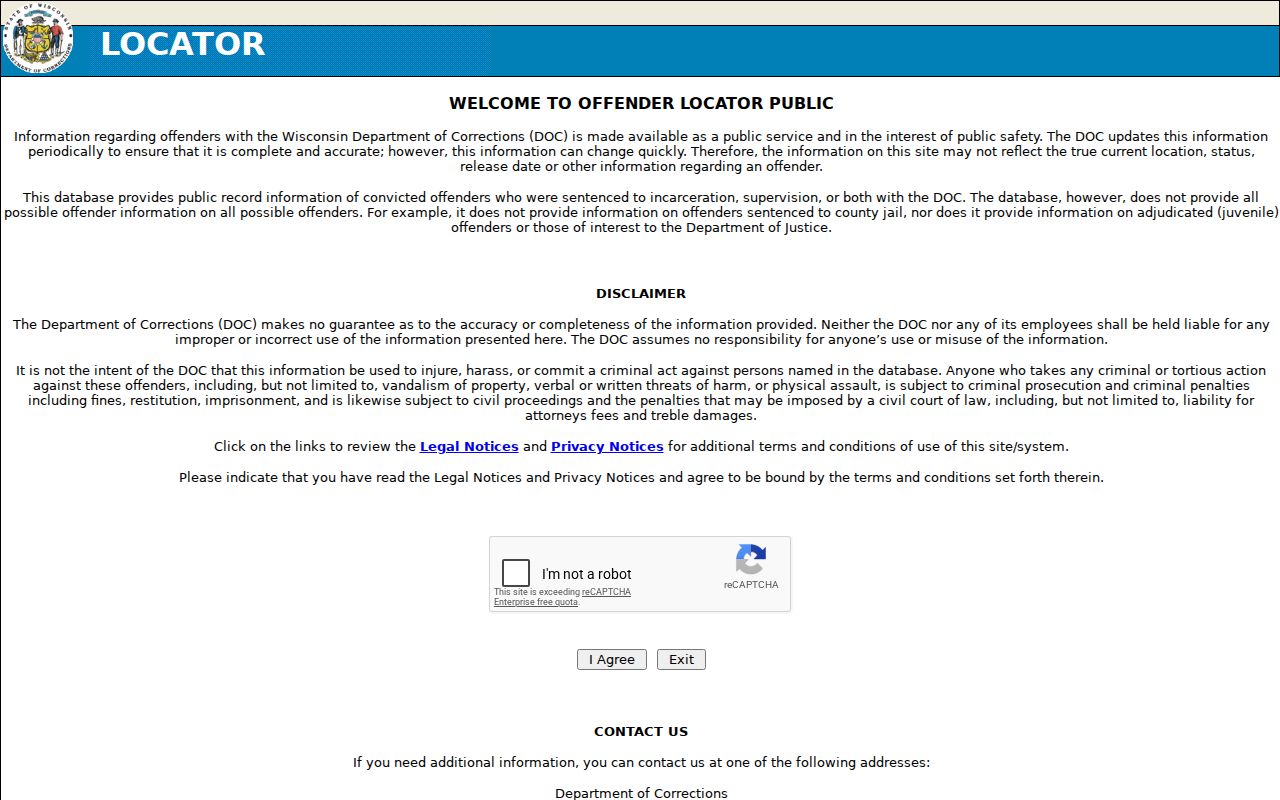
Use the county sheriff for a county booking question and DOC for a person in state prison. VINE/VINELink can send custody notifications, but it is not a complete list of Wisconsin residents or a full case file.
The Wisconsin Sex Offender Registry has its own name and geographic search routes, public-use conditions, and limits on the address details it displays. The official Wisconsin registry page also warns about callers impersonating registry or DOC staff and demanding money.
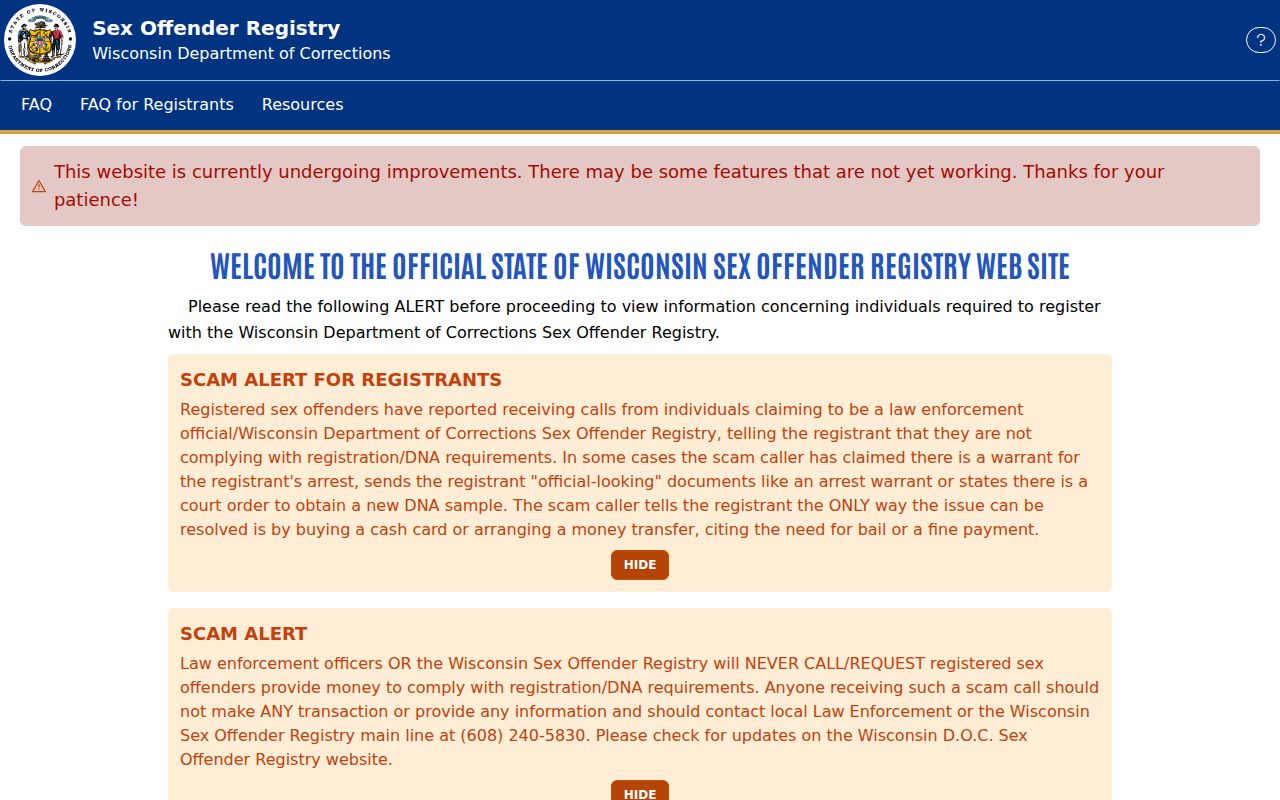
Do not pay an unsolicited caller who threatens arrest or registration consequences. Verify a notice through the registry's published number, (608) 240-5830, or the relevant law-enforcement office. Registry information is for lawful public-safety use; its conditions prohibit harassment, threats, vandalism, assault, or other criminal acts against registrants or their families.
Why Wisconsin Resident Records Stay Hidden
A missing result in a Wisconsin record search can reflect a legal privacy rule, a closed case type or a gap in the index. WCCA does not display adoption, juvenile delinquency, child-protection, termination-of-parental-rights, guardianship, civil-commitment and other confidential records as ordinary public case entries. Wisconsin public views also withhold Social Security and credit-card data, passwords, certain victim and witness names or addresses, juror identities and addresses, and most full birth dates. A Wisconsin court file may have a different access status from its public online summary, so the county clerk is the place to ask about a specific record. Wisconsin offers form GF-182 for qualifying mistaken-identity or identity-theft removal and GF-183 for address removal; a dismissal or not-guilty result alone is not enough for GF-182.
Adoption and birth-parent research uses Wisconsin's official adoption-record and confidential-intermediary routes through DHS or the relevant court or custodian. It is not a public web search by name. For a Wisconsin estate question, start with the county probate index and seek the file through the Register in Probate; then compare its dates with an eligible death record, obituary or deed transfer. The Wisconsin Historical Society, Wisconsin Area Research Centers, local libraries and county clerks can help when an index does not reach the years in question. A Wisconsin custodian request should describe the record sought, date range and preferred format rather than ask the agency to answer a broad personal question.
Wisconsin Resident Lookup: Privacy and Lawful Use
Wisconsin's Public Records Law, Wis. Stat. §§ 19.31-19.39, favors access to government records subject to statutory exceptions and a public-interest balancing test. A Wisconsin request goes to the custodian for the record, not necessarily a statewide office. There is no fixed response deadline; an authority responds as soon as practicable and without delay. Fees are limited to actual, necessary and direct costs allowed by law. If a record is wrong or contains protected information, contact the custodian with its document or case number and ask about correction or redaction.
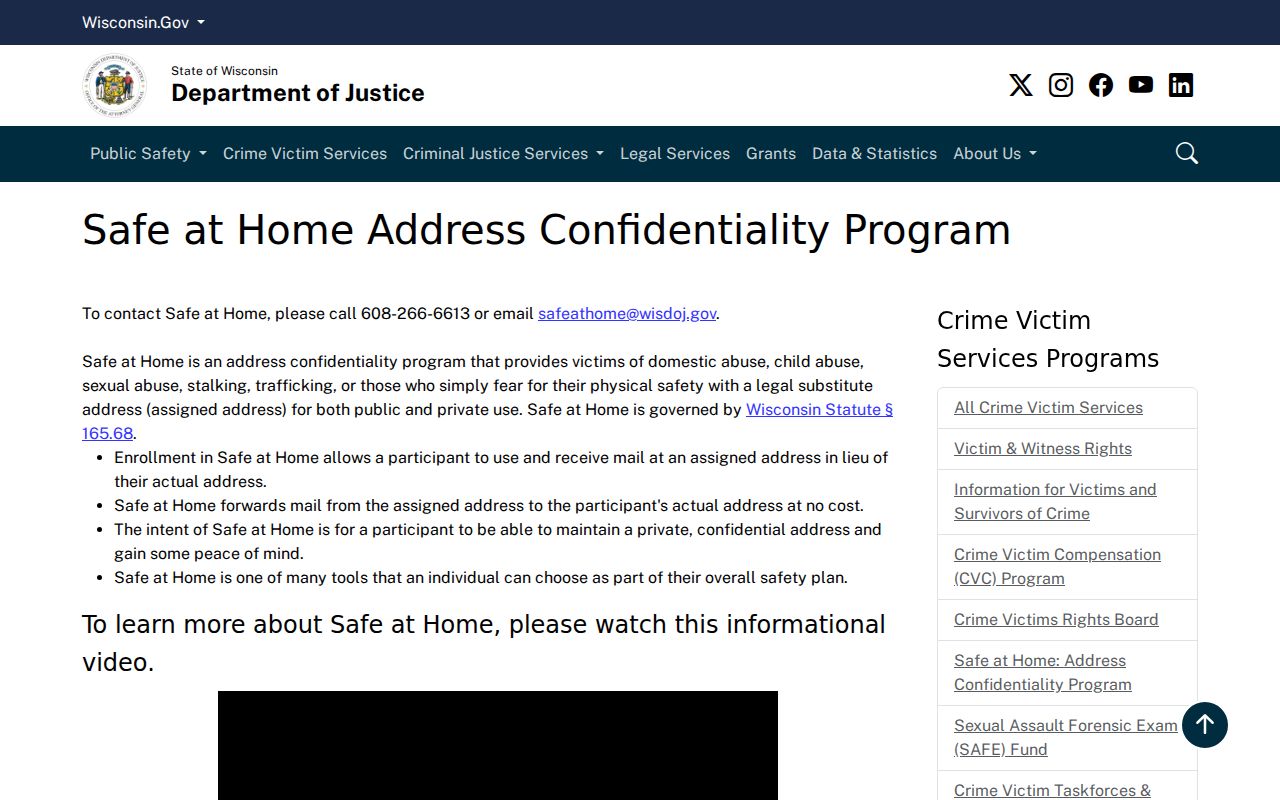
Wisconsin DOJ's Safe at Home program offers eligible Wisconsin residents a legal substitute address. Eligibility covers a Wisconsin resident who is a victim, household member or parent/guardian in a situation involving domestic abuse, child abuse, sexual abuse, stalking, trafficking or fear for physical safety, when the person feared does not know the participant's location and the applicant agrees not to disclose it to them. Applicants work through a designated Application Assistant and should not email the application. The program accepts applications by secure fax at (608) 261-8660 or mail to Safe at Home, P.O. Box 7035, Madison, WI 53707; staff can be reached at (608) 266-6613. The assigned Wisconsin address is accepted for official use. Enrollment also creates property-ownership and other planning questions, so applicants should discuss them with the program. A participant may register as a confidential elector, keeping the actual address from the public portion of the voter list. Judicial officers and qualifying family members may have additional record protections; the relevant custodian can explain the current procedure.
Use a Wisconsin resident lookup for a specific lawful personal purpose, and share only the record details needed for that purpose. Do not use a record or location clue to stalk, threaten, expose or harass someone. Public indexes are not a license to publish a protected address, and a person who needs an official answer should verify it with the record's custodian.
Personal use. Keep the search tied to a legitimate personal question, respect confidentiality rules and stop if the information would expose or endanger someone.