
Wisconsin Previous Residents: Records by Era
For previous residents in Wisconsin, each source answers a different question: a deed records title, a directory places a name at an address in a publication year, and a map shows structures without listing every occupant. Begin with the parcel, then choose records from the period you need.
| Source | Years It Covers | Where Held | What It Shows |
|---|---|---|---|
| Milwaukee County, Wisconsin deed index | Recordings 1962-present; deeds from 1948 by party/tract/doc; 1835-1948 by doc or book/page | Register of Deeds, Tapestry, Laredo, counter | Parties, instrument, date, and legal description |
| Milwaukee County, Wisconsin Digital Reel | City Tax Assessor indexes, roughly 1920s-1989 | Milwaukee Register of Deeds | Historical grantor/grantee and tax-key index |
| Milwaukee, Wisconsin directories | 1847-present, with gaps; address browse from 1921 | MPL Zeidler Room and library databases | Names and address clues by edition |
| Wisconsin state and territorial census | 1836-1905 | WHS/ARCs in Wisconsin and databases | Dated household snapshots |
| Federal census | 1790-1950; most of 1890 lost | NARA, WHS/ARC, databases | Household details in many years; 72-year release rule |
| Wisconsin Sanborn maps | Mostly 1883-1930; 325 communities | WHS, ARCs, UWM, Milwaukee | Building and street context, not residents |
| Permits and tax rolls | Local; Milwaukee, Wisconsin rolls 1846-1984 on microfilm | Wisconsin municipal offices, assessors, treasurers, MPL | Applicant, owner, assessment, or tax clues |
| Obituaries, probate, cemeteries | Wisconsin Necrology Index (WNI) mostly 1870-1970; local runs vary | WHS, Wisconsin libraries, newspapers, courts, cemeteries | Death, family, estate, or transfer leads |
Start with the Wisconsin local assessor and deed index for recent ownership. For older households, add census, tax, plat, and map records. The Milwaukee County years listed here apply only in that county, not across Wisconsin.
Wisconsin Previous Residents: Start by Parcel
Start with the parcel, not today's occupant. A Wisconsin local assessor may show owner, site address, tax key, legal description, sale date, and building details. Wisconsin's V12 parcel layer is a county-sourced discovery map, not title evidence; confirm at the local assessor and Register of Deeds.
For a Wisconsin parcel, keep site address, tax-mail address, postal last line, and legal description distinct. None alone shows who occupied a building in an earlier year.
For a Wisconsin municipal permit, check the local portal first. If no index exists, give the building office the address, permit type, and approximate date, then ask the clerk which custodian holds the file.
Wisconsin Previous Residents and Milwaukee Deeds
In Milwaukee County, Wisconsin, index modes change by era. Recordings from 1962 forward are searchable by grantor, grantee, tract, or document number. Deeds from April 1, 1948 forward use those modes; deeds from 1835 through March 31, 1948 require a document number or book/page. Its Digital Reel has City Tax Assessor grantor/grantee indexes from roughly the 1920s through 1989. These dates apply only to Milwaukee County.
The Milwaukee County Register of Deeds' real-estate records page routes occasional users to Tapestry EON and account users to Laredo. The counter is at 901 N. 9th Street, Room 103, Milwaukee, WI 53233, open weekdays from 8 a.m. to 4 p.m. Older books or microfilm are the fallback when an online mode ends.
Use the deed's legal description or prior reference to continue backward. County copy and image fees vary; Wisconsin's statutory copy baseline is $2 for the first page, $1 per added page, and $1 for certification. Check the county schedule and order certified copies from the Register.
Wisconsin's Milwaukee House Histories: Past Residents
MPL's Wisconsin house-history guide shows how records can be joined around one building. Its Architecture Index has more than 3,000 citations from over 70 books; the Architecture and History Inventory may give a construction date, style, historic name, or prior research. Milwaukee, Wisconsin premises records cover some buildings existing from 1888 to 1980. Milwaukee, Wisconsin address-browsable directories begin in 1921, and tax rolls on microfilm cover ownership, assessment value, and property tax from 1846 to 1984. These are local Milwaukee holdings.
MPL's published house-history guide lays out the library's address-based research route and the sources it recommends.
Log each source separately because an index citation, directory entry, permit, tax roll, and deed answer different questions. WHS's AHI example for 520 S. Baird Avenue in Rhinelander, Wisconsin, traces a 1920 bungalow through tax rolls and directories, names early and later residents, links one resident to a grocery business, and dates a garage to a 1988 permit.
Wisconsin Sanborn Maps for Past Residents
Sanborn fire-insurance maps help date and describe a structure. Wisconsin sets mostly cover 1883-1930; WHS holds maps for 325 Wisconsin communities and more than 700 digitized sets made in 1926 or earlier. Pre-1923 Wisconsin maps are digitized. Physical maps are noncirculating at WHS or an ARC. Search by Wisconsin town, date, and keyword, then note the sheet and street.
WHS's Sanborn map collection page explains the online and physical access routes.
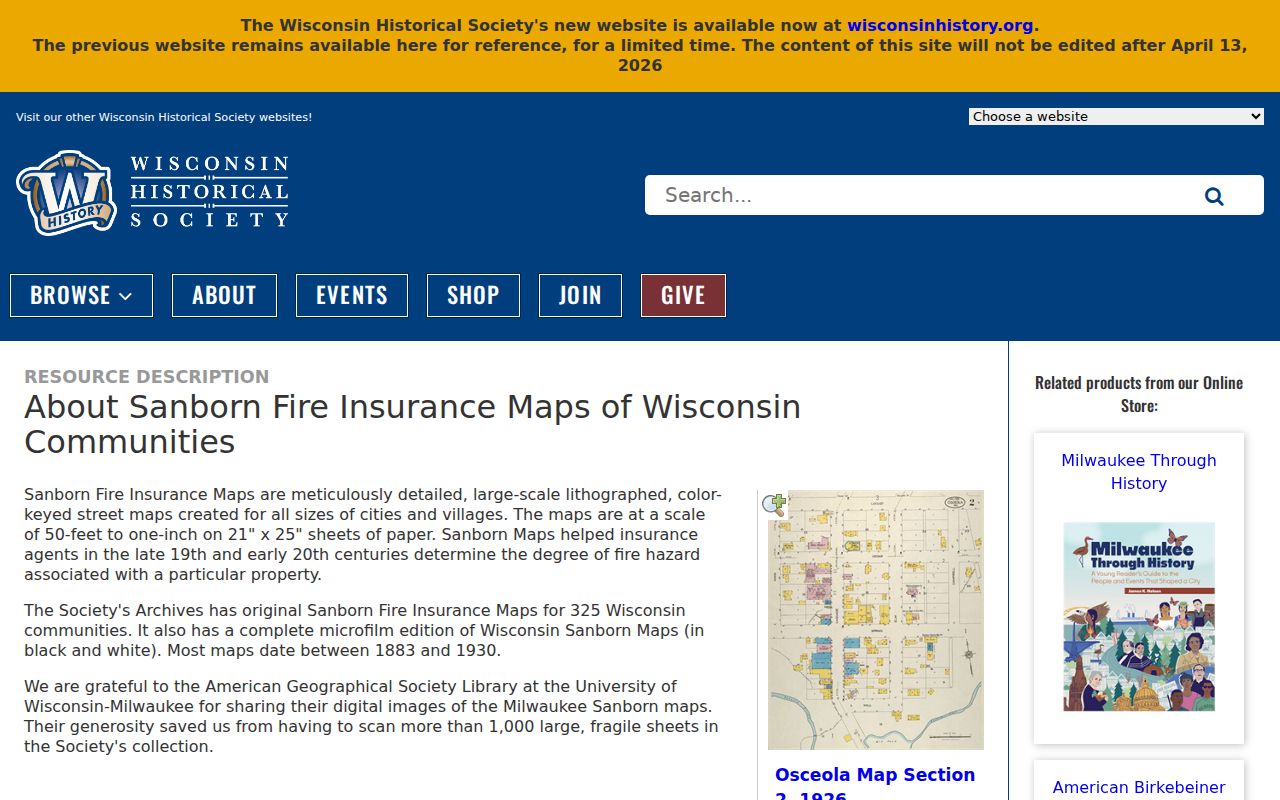
Map symbols can show building outline, stories, materials, use, and nearby streets or utilities. A Sanborn sheet can establish that a building existed and help match an old lot to a later address, but it does not name the household. Pair it with a dated directory, census, tax roll, or deed.
Follow Wisconsin Deeds Back to Prior Owners
A Wisconsin chain-of-title search follows recorded transfers backward from a known parcel. Begin at the local assessor or county land-information site, then use the Register of Deeds index. If a portal has only party-name search for a given era, use the current owner's purchase deed to learn the seller and the legal description before moving back another step.
- Record the parcel ID, current owner, site and mailing addresses, legal description, and latest sale information from the local Wisconsin assessor.
- Search the Wisconsin county deed index for the current owner as grantee near the likely purchase date; use the parcel, tract, or document mode if offered.
- Open the deed and record the grantor, grantee, instrument date, recording date, document number, book/page, and legal description.
- Search the seller as a prior grantee, carrying the same legal description or tract and allowing for spelling, initials, spouse, trust, or estate names.
- When the online index reaches its cutoff, move to the Wisconsin county's older document-number or book/page route, Digital Reel, counter books, archive, or microfilm.
- Grantor and grantee
- The grantor conveys an interest; the grantee receives it. A deed-index result identifies parties and an instrument, not everyone who occupied the parcel.
- Chain of title
- The sequence of recorded instruments linking ownership claims to a parcel over time.
- Legal description
- The formal land description in the deed, such as a lot and block or a survey-based description. It can connect older records when a street number changed.
- Situs and mailing address
- Situs identifies the physical parcel; the mailing field is where tax correspondence is sent. They may be different addresses.
Record the instrument or page reference at each step so another researcher can repeat the path. A deed proves a recorded transfer or title instrument. It does not show that a buyer moved into the building, or that all household members were named in the instrument.
Madison, Wisconsin Address Changes Hide Previous Residents
Madison, Wisconsin's 1883-84 book says lake-to-lake streets counted from Lake Monona; northeast and southwest streets counted from Wisconsin Avenue, except Main and Wilson, which counted from the railroad. Milwaukee, Wisconsin's 1930 Address Change Directory includes 1931 street-name changes in Wauwatosa, Wisconsin. An old number or name may differ from the modern form even when it describes the same place.
Before calling a name absent, compare the old spelling with the volume's directions, a plat, Sanborn sheet, and current legal description. Keep the original Wisconsin address and a modern form in separate fields, then use a recorded map or deed to test the match.
Match Wisconsin Directory and Census Years
Owners are only one part of a former-address story. Directories may place a person or household at a street address in a publication year, while census schedules provide a household snapshot at a wider interval. The editions and catalog routes for each Wisconsin run are covered on the city directory collections page; use those records to trace previous residents at a particular address across time.
| Wisconsin directory year | Search by name, then by street and number when the volume has an address-order section. Keep the publisher's exact spelling and any key marks. |
|---|---|
| Closest census | Compare the nearest available federal census and Wisconsin state or territorial census. A census is a dated snapshot, not an annual update. |
| Parcel and map | Use a plat, assessor record, or Sanborn sheet to test whether the street and number refer to the same place over time. |
| Family endpoint | Use an obituary, probate case, cemetery record, church register, or local newspaper to explain a move, death, or transfer when the source supports it. |
Federal individual census records are public through 1950 under the 72-year rule. Most of the 1890 population schedules were destroyed, while Wisconsin state and territorial census material from 1836-1905 fills some gaps. A census may describe a location without the modern street format, so preserve enumeration district, ward, township, or other printed geography alongside the household names.
- Criss-cross directory
- A directory's street-order section, where available, used to look up names or businesses by address.
- Enumeration district
- The geographic unit assigned to an area in a federal census. It helps locate schedules but does not necessarily match a modern parcel or neighborhood.
When a person disappears from an address, possible explanations include a move, death, a changed number, a missing edition, or an index miss. A Wisconsin heir trail may continue from a probate file to an obituary, deed transfer, and cemetery record, but each link should be supported by its own date and source.
House-history use. Use this method for documented building history, family research, and personal curiosity. These clues do not form a current resident list, and they are not a reason to track or contact a living former occupant.
Wisconsin Archives for Prior Residents
Wisconsin became a state in 1848, but county record starts vary. Check a Register guide, historical society, WHS catalog, or ARC finding aid for an early deed date.
Wisconsin local governments must notify WHS before destroying obsolete records. The Society processes lasting material, returning many records to regional ARCs. WHS holds Dane, Sauk, and Columbia county records at its Madison, Wisconsin, headquarters; other Wisconsin county holdings go to regional centers. Some items travel to another Wisconsin ARC; rare local-history material may stay onsite.
For Wisconsin records, search by county, office, record type, creator, and date. Deed indexes, tax rolls, probate, naturalization, and court records may survive after an online portal ends.
Where Wisconsin's Resident Trail Ends
A Wisconsin estate transfer may lead to probate and newspaper evidence. The Wisconsin county Clerk of Circuit Court or Register in Probate holds estate files; Wisconsin Circuit Court Access (WCCA) shows public summaries, while filed documents come from Wisconsin county court. Obituaries, cemetery records, and church registers can explain a move or death, but remain clues unless confirmed by a custodian.
Wisconsin required county birth, marriage, and death registration beginning in 1852, but compliance was uneven until about 1880. WHS's Wisconsin pre-October 1907 collection is useful but incomplete. A missing entry is not proof of death; preserve the date and source reference.