
Wisconsin City Directory Collections by Community
No single Wisconsin collection covers every town and year. Local libraries, the Wisconsin Historical Society (WHS), its Area Research Centers (ARCs), UW-Madison, and library databases hold separate runs. Search by community, county, publisher, and date because a catalog may file a volume under an older place name or creator.
| Collection | Years or coverage | Where held | Access |
|---|---|---|---|
| Milwaukee, Wisconsin series | 1847-present, with gaps; address browse 1921-present | MPL Zeidler Room and library databases | Print, fiche, film, and licensed online access |
| Madison, Wisconsin books and advertiser | 1871-72 and 1883-84 examples | UW Digital Collections | Full-view scans |
| Wright's Janesville, Wisconsin volume | 1913 title; catalog date 1912 | WHS Wisconsin County and Community Histories | Page images and item record |
| Other Wisconsin local runs | Varies by community and publisher | WHS/ARC and local libraries | Search town, county, creator, and date |
| HeritageQuest | U.S. records 1821-1989; local titles vary | BadgerLink and Wisconsin libraries | Library or Wisconsin resident login may apply |
| Farm and patrons' directories | Includes a 1914 Wisconsin Polk County atlas | WHS digitized maps and atlases | Often rural landowners, not city households |
| Telephone books | Wisconsin local runs vary | MPL and local libraries | Check the catalog for a town and year |
The table is a finding aid for Wisconsin research, not a promise that every year survives or was published. Milwaukee, Wisconsin, has gaps, and some Wisconsin towns have only a few volumes in the catalogs consulted. Ask the holding library whether a scan, reel, or noncirculating book is available.
Wisconsin's Milwaukee City Directory Run Has Gaps
MPL describes the Wisconsin run for Milwaukee as beginning in 1847 and continuing to the present, with gaps. The Zeidler Room has print volumes for 1848/49-1922 and 1923-present, fiche for 1847-1860, and film for 1861-1960. Ancestry Library Edition has an online run for 1861-1960. MPL says names can be browsed across the run and addresses from 1921 forward.
Milwaukee Public Library's Zeidler Room page describes the Wisconsin local-history room's directory formats and its Address Change Directory. The image below points to that holding guide, where the reader can confirm current access details before planning a visit.
The 1930 Address Change Directory for Milwaukee, Wisconsin, is especially useful for a backward address search. Its end includes 1931 street-name changes in Wauwatosa, Wisconsin, so a name missing under a modern street spelling may still be indexed under the earlier form. Treat the change list as a search aid, not proof that a particular household moved.
Wisconsin Digitized City Directories
Digitized scans cover selected Wisconsin local volumes. UW catalogs Madison, Wisconsin's 1871-72 directory and business advertiser separately from its 1883-84 volume. The later book has a street section with original numbering directions. WHS lists Wright Directory Co.'s 1913 Janesville, Wisconsin title; its 338-page record says it was created in 1912.
UW Digital Collections' Madison, Wisconsin directory record describes the 1871-72 item. Use its catalog details to locate the scan, then cite the printed title and page.
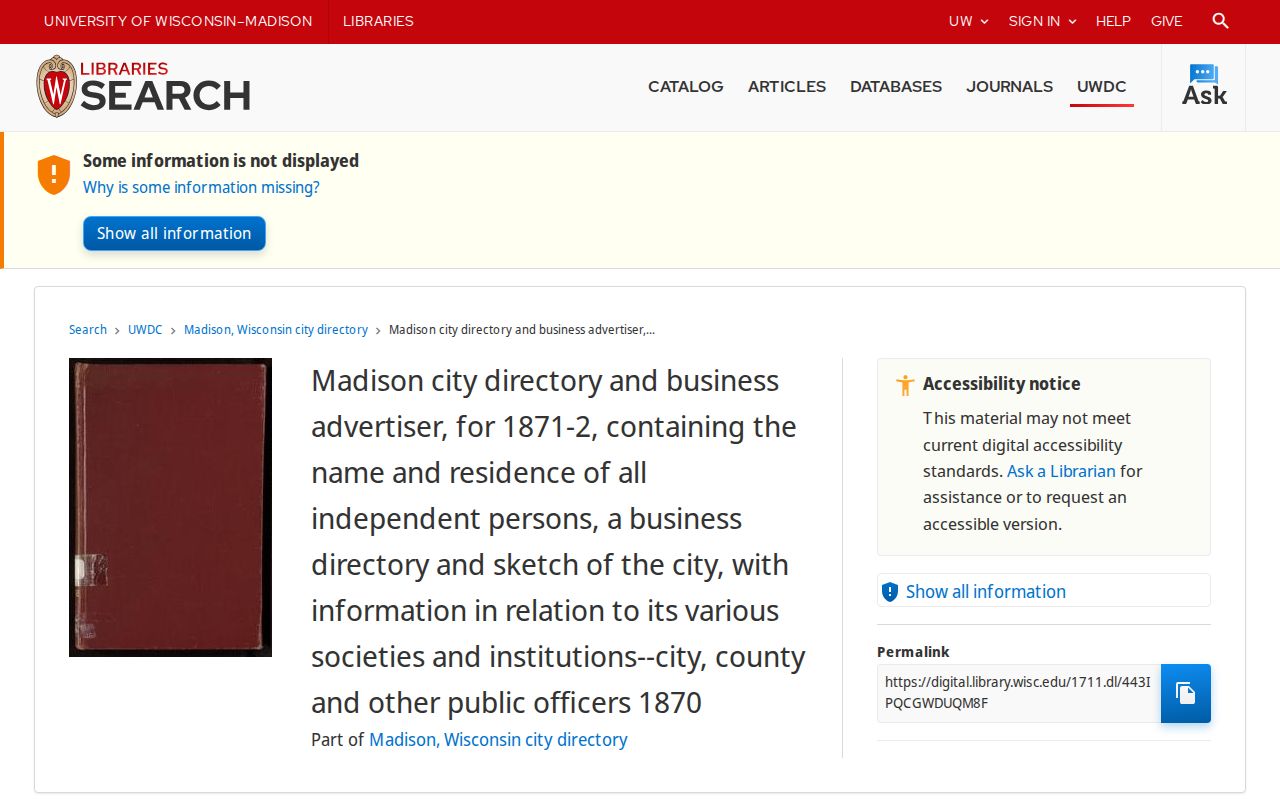
This Wisconsin item-level catalog page is not a statewide index. Open the volume to inspect its headings and printed instructions instead of relying on a search-result snippet.
WHS's page for Wright's directory of Janesville, Wisconsin, for 1913 provides page thumbnails and publication metadata.
That Janesville, Wisconsin, record shows why both the printed year and the catalog date belong in research notes. Check the title page and the entry itself; do not assume the metadata field is the date printed on every page.
Wisconsin Archives Route City Directories
WHS and the 14 Wisconsin Area Research Centers (ARCs) provide the broadest statewide route, but the material is not all in Madison, Wisconsin. Wisconsin catalogs cover local government, newspapers, maps, tax rolls, naturalization, cemetery, church, school, and community records. The Society processes many Wisconsin local-government records and returns them to a regional Wisconsin ARC. Some items can be requested elsewhere; rare Wisconsin genealogy and local-history materials may need onsite use. Confirm hours and whether an item is available before traveling.
WHS's family-history collection overview maps out indexes and archival collections that can extend a directory clue.
Use a Wisconsin catalog as a routing tool: note the repository, call number, collection name, and any access note, then contact the holding site about transfer or staff help. A catalog entry describes what survives; it does not mean every name in the volume is indexed online.
Read Wisconsin City Directory Entries
A Wisconsin volume can have several useful sections, not just an alphabetical list of residents. The 1871-72 Madison, Wisconsin, title describes names and residences of independent persons, business listings, a city sketch, societies and institutions, and city, county, and public officers. The Milwaukee, Wisconsin series may include spouse or widow notation, occupation, address, and a household or business code. These fields vary by year and publisher, so the Wisconsin book's own front matter is the authority for its abbreviations.
| Name and spouse | Copy the printed spelling, initials, and any spouse or widow notation. Do not infer a modern relationship from a short form. |
|---|---|
| Occupation or business | Some books print an occupation or business name; the field and detail vary by edition. |
| Street address | Record the number, street spelling, unit or room notation, and the volume page. Cross-check with the street-order section where one exists. |
| Household or business mark | Some Wisconsin volumes distinguish a private household from a business. Owner, renter, roomer, rear, and telephone marks must be read from that book's key. |
| Institutional listing | Officers, societies, public bodies, or organizations may be listed separately from household names. |
For a reproducible note, save the title, publisher or compiler, year, page, and the exact mark beside the entry. A directory reports what its publisher printed for that edition. It does not establish deed ownership, current occupancy, or a complete list of everyone in a household.
- Criss-cross directory
- A street-order section that places names or businesses under an address sequence when the volume includes one.
- Householder index
- An alphabetical route into a volume's named residents or householders; check the particular volume because indexes differ.
- Abbreviation key
- The volume's explanation of shorthand such as occupation, address, spouse, or telephone marks. Read it before interpreting a symbol.
- Address browse
- A way to search a directory by street and number when the year has a reverse section. Milwaukee, Wisconsin address browsing is documented from 1921 onward.
Check Wisconsin Directory Abbreviations in the Volume
Before comparing Wisconsin editions, confirm whether a volume covers one city or a wider region, lists residents or businesses, and has a street-order section. Read the Wisconsin volume's front matter for marks such as “h,” “r,” “wid,” telephone symbols, wards, or occupation shorthand. A familiar letter can mean something else in another book.
Preserve uncertainty: “Mrs.” may not identify a spouse, and “r” may mean room, rear address, or renter only if the volume's key says so. A rural route, unnumbered street, missing year, or spelling change can explain a gap. Compare the name and address sections with an independent record.
Madison, Wisconsin's 1883-84 Numbering Directions
The digitized 1883-84 Madison, Wisconsin book gives a clear example of how local street numbering can shape a search. It says lake-to-lake streets start their numbers at Lake Monona. Northeast and southwest streets count from Wisconsin Avenue, except Main and Wilson, which count from the railroad. A number copied from the volume may therefore point to a different block than a modern map suggests.
| Milestone | What the record shows | Research use |
|---|---|---|
| Milwaukee, Wisconsin, 1847 | Beginning of the documented local directory run | Names browse across the series; address browse begins in 1921 |
| Madison, Wisconsin, 1871-72 and 1883-84 | Two separately cataloged directory examples | Use the printed street directions in the later volume |
| Janesville, Wisconsin, 1913 title | Wright Directory Co. item with 1912 creation metadata | Keep title year and catalog date distinct in citations |
Milwaukee, Wisconsin's 1930 Address Change Directory and its notice of 1931 Wauwatosa, Wisconsin, street-name changes offer another bridge across changing labels. Check the old street name, cross street, and numbering directions before deciding that a person is absent. Keep the original address string alongside a modern normalized form when researching Wisconsin streets.
Track Wisconsin Households Across Directory Years
For Wisconsin family history, treat each edition as a dated clue and build a small timeline. Begin with a known Wisconsin city and approximate year, then follow a household through nearby editions and compare addresses with census and parcel evidence. If the goal is the occupants of one house across time, the previous residents page covers the address trail separately from this guide to the historical collections.
- Find the likely name in the alphabetical section and note the exact page and printed form.
- Check the address section, if present, and copy the street number and spelling as printed.
- Repeat in nearby editions, allowing for gaps, initials, changed spelling, and a move.
- Pair each directory clue with the closest federal or Wisconsin state/territorial census available.
- Use a map, plat, obituary, cemetery record, or probate file to test what changed.
Federal census individual schedules are public through 1950 under the 72-year release rule; most of the 1890 population census was destroyed. Wisconsin state and territorial census material covers 1836-1905 and can fill some local gaps. In Wisconsin research, a vanished directory entry may mean a move, death, a publication gap, or an indexing miss. Seek another dated source before choosing among those explanations.
Match Wisconsin Directory Entries to Census Records
WHS's Wisconsin Name Index covers county histories, biographies, selected newspapers, and obituary scrapbooks, including more than 30,000 clippings in Wisconsin Necrology. The Local History and Biographical Articles collection has 16,000 digitized articles, mostly from 1860-1940. Treat both indexes as leads and cite the underlying scan when available.
The Wisconsin Digital Newspapers map filters titles by county, city, date, and access. WHS cemetery holdings include transcriptions, church burial registers, histories, and original burial-association records. Church and diocesan registers can fill gaps from before civil registration became more consistent around 1880. Yearbooks, naturalization files, local histories, and university collections may explain a move or name variant.
A directory entry places a person in one Wisconsin edition. An obituary or probate file may explain a later change. Keep each source date distinct and avoid turning clues into a claim the records do not make.
Wisconsin City Directories Reflect Distinct Local Communities
Wisconsin records vary by community. Milwaukee, Wisconsin's port and manufacturing history left long directory, telephone, business, map, and newspaper runs. Madison, Wisconsin's university and government setting has campus archives, yearbooks, rosters, and old street directions. Wisconsin's Fox River Valley sources include local histories and plat books; rural northern and western Wisconsin research may rely on farm directories, church registers, cemeteries, county histories, and ARC microfilm.
A rural Wisconsin atlas may name landowners rather than city residents, while a yearbook may name an association but not a household. Match the source to the question and preserve its limits. Record the year, place, page, and reading key, then compare with census or map evidence.